 Christy Lyn Guerrero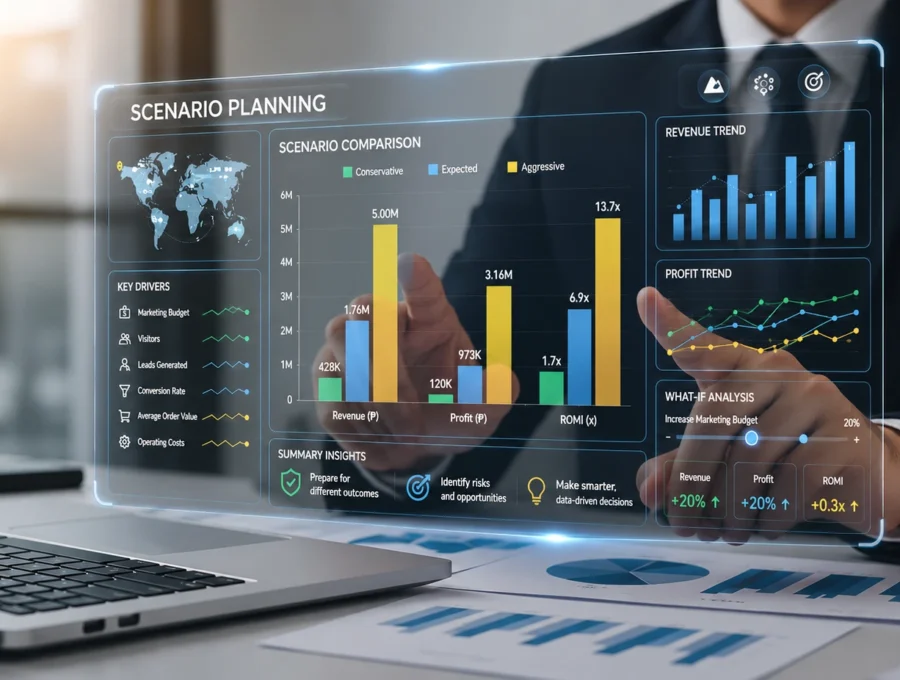
Why One Forecast Isn’t Enough
If you’ve ever presented a marketing forecast only to watch the actual results fall short—or exceed expectations—you’ve experienced one of the biggest limitations of relying on a single forecast. Forecasts are built on assumptions, but those assumptions rarely stay constant. Customer demand shifts, advertising costs fluctuate, competitors launch new campaigns, and economic conditions change—often when you least expect them.
This is where scenario planning becomes valuable. RatherRather than relying on a single prediction, it evaluates multiple plausible outcomes based on different assumptions—a practice that has shaped corporate strategy at companies like Shell for decades. Instead of asking, “What will revenue be next quarter?”, organizations ask, “What could happen under different business conditions, and how should we prepare?”
For marketing teams, scenario planning provides a practical way to evaluate uncertainty before making investment decisions. By comparing Conservative, Expected, and Aggressive scenarios, organizations can better understand potential risks, identify growth opportunities, and make more informed business decisions.
In this blog, you’ll learn what scenario planning is, identify the key drivers of business performance, build multiple forecasting scenarios, compare projected revenue and profit, and use what-if analysis to support smarter marketing decisions.
What is Scenario Planning?
Scenario planning is a strategic forecasting approach that evaluates multiple plausible future outcomes based on different sets of assumptions. Rather than producing a single prediction, it examines how changes in business drivers—such as customer demand, marketing performance, pricing, or operating costs—may influence the future and may influence revenue forecasting, profit forecasting, and overall business performance.
Unlike traditional forecasting, scenario planning recognizes that uncertainty is part of business. Instead of assuming current trends will continue, it helps organizations prepare for different possibilities and evaluate how changing conditions may affect financial performance.
The goal isn’t to predict the future with complete accuracy. Instead, scenario planning helps decision-makers compare risks, evaluate opportunities, and develop strategies that remain effective under different business conditions.
Throughout this blog, we’ll demonstrate this process using a sample marketing forecasting model that compares Conservative, Expected, and Aggressive scenarios.
The Key Drivers of Business Performance
Every forecasting scenario begins with assumptions, but those assumptions should be based on measurable business drivers rather than guesswork. Identifying the variables that influence revenue and profit helps organizations build forecasts that are realistic and actionable.
The sample marketing forecasting model used throughout this tutorial focuses on the business drivers shown below.
Table 1. Key Business Drivers Used in the Sample Marketing Forecasting Model
| Business Driver | Description |
|---|---|
| Marketing Budget | The amount invested in marketing campaigns and customer acquisition. |
| Website Visitors | The number of users visiting the website during the reporting period. |
| Leads Generated | Potential customers who express interest in the business. |
| Conversion Rate | The percentage of leads that become paying customers. |
| Customers Acquired | The number of new customers gained during the period. |
| Average Order Value (AOV) | The average revenue generated per customer transaction. |
| Revenue | Total income generated from customer purchases. |
| Marketing Costs | Expenses directly related to marketing activities. |
| Operating Costs | Business expenses required to deliver products or services. |
| Profit | Revenue remaining after deducting marketing and operating costs. |
| Return on Marketing Investment (ROMI) | Measures how effectively marketing investment contributes to business performance. |
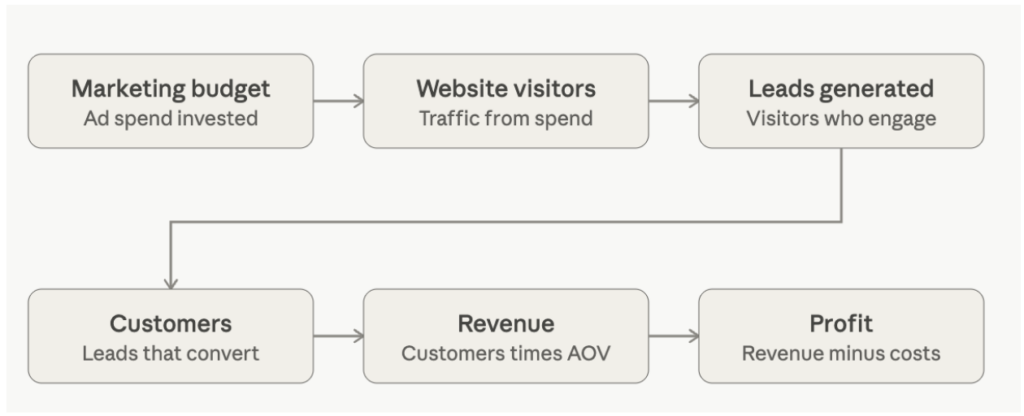
These business drivers form the foundation of the forecasting model used throughout this blog. In the next section, we’ll use them to build Conservative, Expected, and Aggressive scenarios and compare their impact on projected business performance.
Building Conservative, Expected, and Aggressive Scenarios
Most forecasting models begin with three scenarios: Conservative, Expected, and Aggressive. Together, they provide a realistic range of possible outcomes, helping organizations prepare for uncertainty instead of relying on a single forecast.
This tutorial demonstrates the process using a fictional marketing dataset. Although the data is created for demonstration purposes, the workflow reflects how organizations build scenario-based forecasts for business planning.
Creating a Simple Scenario Planning Model
The sample forecasting model follows eight steps, from identifying business drivers to comparing projected revenue and profit. By keeping the calculations consistent and changing only the assumptions, organizations can evaluate how different business conditions affect financial performance.
Step 1 — Identify Your Business Drivers
Begin by identifying the variables that have the greatest influence on business performance. These become the assumptions that change across different forecasting scenarios.
The model uses the following business drivers:
- Marketing Budget
- Website Visitors
- Leads Generated
- Conversion Rate
- Customers Acquired
- Average Order Value
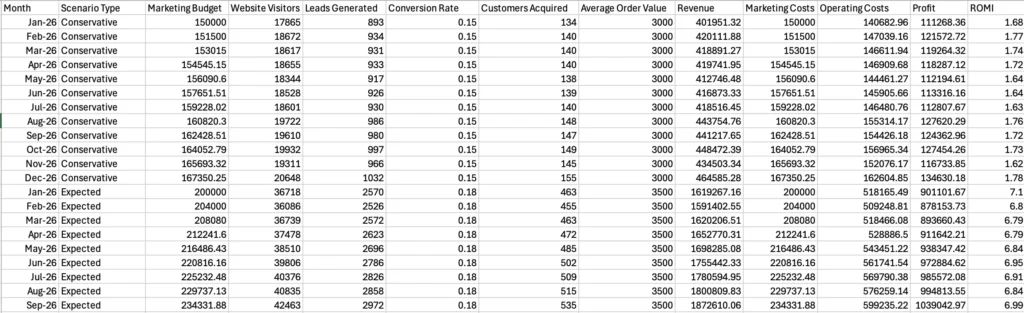
Step 2 — Collect Historical Performance Data
Historical data provides the foundation for business forecasting. It helps establish realistic assumptions based on past marketing and financial performance rather than guesswork.
Step 3 — Establish Baseline Assumptions
The Expected scenario serves as the planning baseline because it reflects typical business performance based on historical trends.
Table 2. Expected Scenario Assumptions
| Business Driver | Baseline Assumption |
|---|---|
| Marketing Budget | Historical average |
| Website Visitors | Historical trend |
| Conversion Rate | Historical average |
| Average Order Value | Current average |
| Marketing Costs | Current budget |
| Operating Costs | Current operating expenses |
Steps 4–6 — Build the Forecasting Scenarios
After establishing the baseline, create three scenarios by adjusting the business assumptions while keeping the forecasting model unchanged.
Table 3. Comparison of Forecasting Scenarios
| Scenario | Typical Assumptions | Purpose |
|---|---|---|
| Conservative | Lower demand, fewer conversions, higher operating costs | Prepare for slower business performance |
| Expected | Historical averages and current trends | Establish the primary planning baseline |
| Aggressive | Higher demand, stronger conversions, increased marketing investment | Evaluate potential business growth |
Comparing these scenarios helps organizations understand how changes in business conditions influence projected performance and supports more informed planning decisions.
Step 7 — Compare Projected Revenue and Profit
Once each scenario has been created, apply the assumptions to the same forecasting model. Keeping the formulas consistent makes it easier to identify which business drivers have the greatest impact on projected revenue and profit.
Comparing the three scenarios side by side allows decision-makers to evaluate financial risk, identify growth opportunities, and prepare for different business conditions.
Applying each scenario to the same model makes it easier to isolate the effect of changing assumptions on projected revenue and profit.
Step 8 — Use What-If Analysis to Test Individual Variables
While scenario planning compares multiple sets of assumptions, what-if analysis focuses on changing one variable at a time. This helps organizations evaluate the impact of specific business decisions before implementing them.
In the next section, we'll compare projected revenue and profit across the three scenarios before using what-if analysis to assess how changing the marketing budget influences business performance.
Forecasting Revenue and Profit Under Different Assumptions
Once the scenarios have been established, the next step is applying each set of assumptions to the same forecasting model. Because the calculations remain consistent across all scenarios, differences in the results reflect only the changes in the business assumptions.
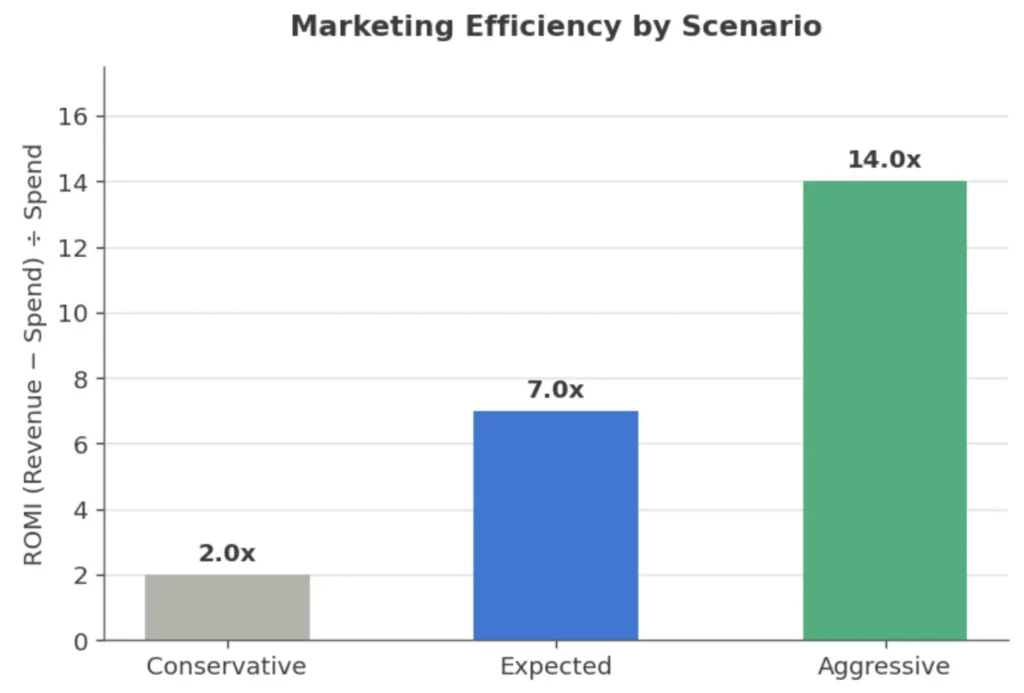
Comparing revenue, profit, and ROMI provides a clearer picture of financial performance than revenue alone.
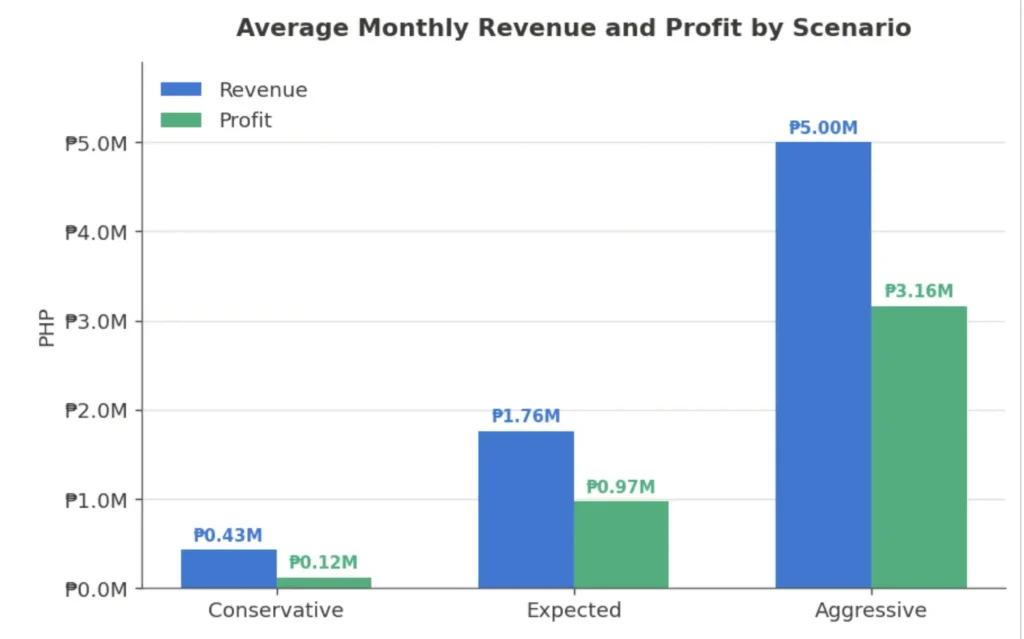
The revenue and profit projections show how changes in marketing assumptions influence business growth. As expected, the Aggressive scenario produces the highest projected revenue, while the Conservative scenario estimates lower revenue under less favorable business conditions. However, higher revenue does not always translate into proportionally higher profit — increased marketing investment and operating costs can offset some of the gains. Comparing revenue and profit side by side helps organizations determine whether projected growth actually strengthens financial performance, rather than just top-line numbers.
Table 4. Summary of Forecast Results
| Metric | Conservative | Expected | Aggressive |
|---|---|---|---|
| Revenue | ₱428,447 | ₱1,759,748 | ₱4,999,745 |
| Profit | ₱119,959 | ₱973,094 | ₱3,159,109 |
| ROMI | 1.7x | 13.7x | 13.7x |
The summary table provides a side-by-side comparison of the forecasting results. In addition to revenue and profit, Return on Marketing Investment (ROMI) helps evaluate how efficiently marketing spending contributes to business performance. Return on Marketing Investment (ROMI)
Using What-If Analysis for Smarter Decisions
While scenario planning compares multiple business conditions, what-if analysis examines the impact of changing a single variable while keeping the remaining assumptions constant. This approach helps organizations evaluate potential decisions before implementing them.
For this tutorial, the marketing budget was adjusted to examine how additional investment affects projected revenue, profit, and ROMI. This allows decision-makers to assess whether increasing marketing spend is likely to generate meaningful business returns.
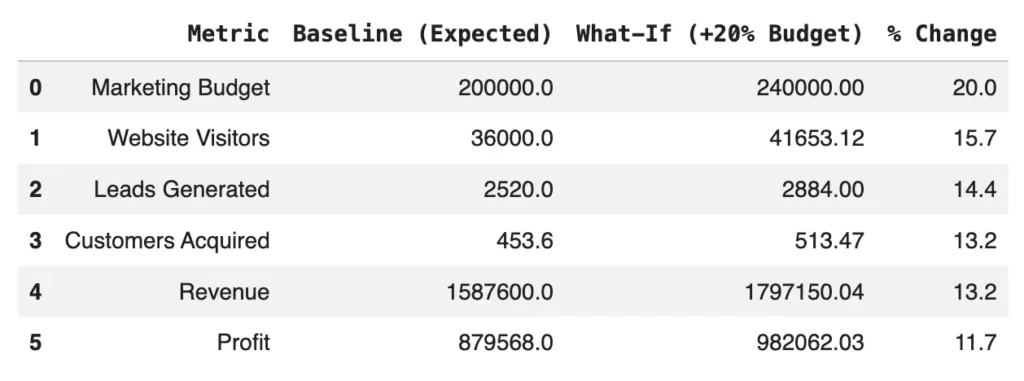
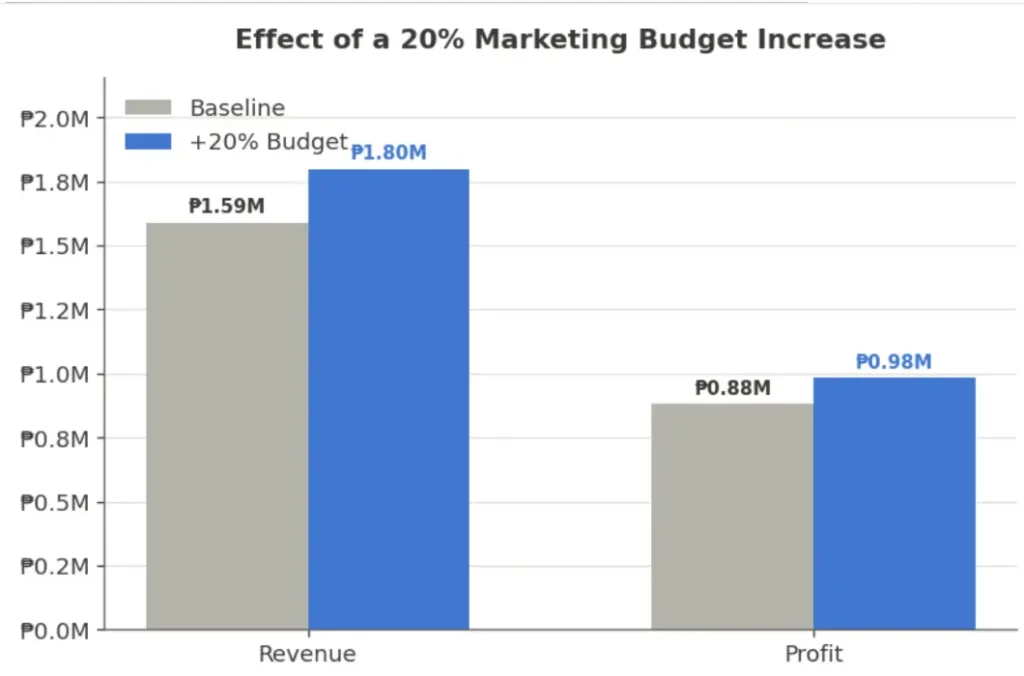
The results demonstrate that increasing marketing investment can improve revenue and profit, but the gains may not always increase proportionally. Evaluating these trade-offs enables organizations to make more informed budgeting decisions and allocate marketing resources more effectively.
Together, scenario planning and what-if analysis provide a practical framework for testing assumptions, comparing possible outcomes, and supporting data-driven business planning.
Common Scenario Planning Mistakes
Even well-designed forecasting models can produce misleading insights if they rely on unrealistic assumptions or are interpreted incorrectly. Scenario planning is most effective when it is treated as an ongoing planning process rather than a one-time forecasting exercise.
Common mistakes include:
- Relying on a single forecast. Evaluate multiple scenarios instead of anchoring decisions to one projection.
- Using unrealistic assumptions that are not supported by historical data or market trends.
- Changing too many variables at once, making it difficult to identify which factors influence the results.
- Ignoring diminishing returns, where increasing marketing investment produces smaller incremental gains.
- Treating scenarios as predictions rather than plausible outcomes for planning.
Avoiding these mistakes helps organizations build more reliable forecasts and make better strategic decisions as business conditions change.
Key Takeaways
Scenario planning helps organizations forecast revenue, profit, and business growth by evaluating multiple possible outcomes instead of relying on a single prediction. When combined with what-if analysis, it provides a practical framework for testing assumptions, comparing alternatives, and supporting data-driven marketing decisions.
Key takeaways from this blog include:
- Scenario planning improves forecasting by preparing for multiple business outcomes.
- Forecasts should be based on measurable business drivers rather than assumptions alone.
- Conservative, Expected, and Aggressive scenarios help evaluate both risks and growth opportunities.
- Comparing revenue, profit, and Return on Marketing Investment (ROMI) provides a more complete view of marketing performance.
- What-if analysis helps assess the impact of changing individual business variables before making strategic decisions.
- Forecasting models should be reviewed regularly to reflect changing market conditions and business objectives.
Scenario planning is most effective when forecasts are reviewed regularly and updated as business conditions change. By incorporating multiple scenarios into the planning process, organizations can make more informed decisions, allocate resources more effectively, and build more resilient business plans..
Looking to build data-driven forecasting models for your business? Data2Stats helps organizations transform historical data into actionable insights through analytics, dashboards, and forecasting solutions.