 Joanna Althea Ranario
Introduction
Marketing success isn’t just about increasing sales, it is also about generating profitable growth while keeping advertising costs under control. Many e-commerce businesses probably tracked ROAS (Return on Ad Spend) for individual campaigns. But ROAS only tells part of the story.
That’s where Marketing Efficiency Ratio (MER) comes in. MER gives you a bird’s eye view of your entire marketing spend and total revenue, helping you make smarter, big-picture decisions instead of chasing individual campaign metrics.
This guide explains what MER is, how to calculate it, how it differs from ROAS, why it matters, common benchmarks, limitations, and how data analysis can improve its interpretation.
What is Marketing Efficiency Ratio (MER)?
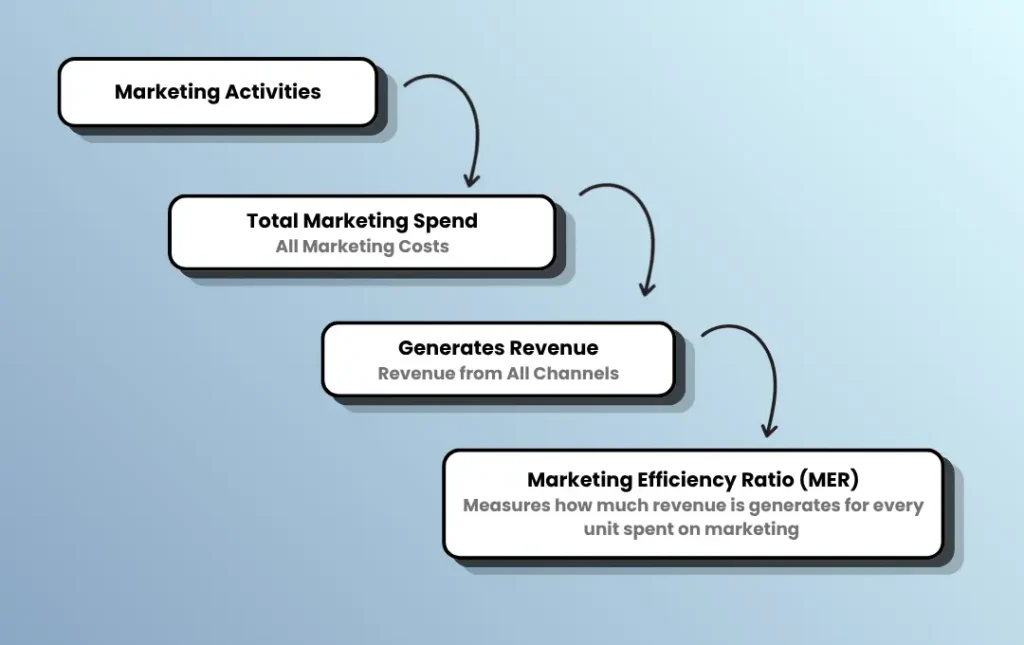
Marketing Efficiency Ratio (MER) is a performance metric that measures how much revenue a business generates for every unit spent on marketing. Unlike campaign-specific metrics, MER evaluates the combined impact of all marketing activities, providing a broader view and understanding of marketing performance.
Instead of asking “How did this specific Facebook ad perform?” MER asks a bigger question: “How much revenue did my entire marketing budget generate?”
This makes MER especially useful for founders, chief marketing officers (CMOs), and finance teams who need to evaluate overall marketing performance without getting lost in channel-by-channel metrics.
MER Formula Explained
Once you understand what Marketing Efficiency Ratio (MER) measures, the next step is learning how to calculate it.
The formula for the Marketing Efficiency Ratio
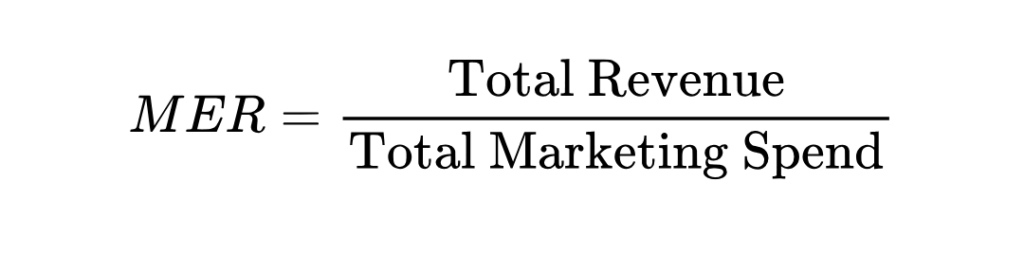
Where:
Total Revenue refers to all revenue generated during the selected period.
Total Marketing Spend includes all marketing expenses, including:
- Paid advertising (Google Ads, Meta Ads, Tikto Ads)
- Email marketing platforms
- Influencer partnerships
- Affiliate commissions
- Creative production
- Agency or freelancer fees
Sample MER calculation
For example, if an online store generates $500, 000 in revenue while spending $100, 000 on marketing, its MER is 5.0. This means the business earns $5 in revenue for every $1 spent on marketing.
Generally, a higher MER indicates more efficient marketing spend. Since MER considered total marketing spend, it is particularly valuable for businesses that use multiple channels simultaneously.
MER vs ROAS
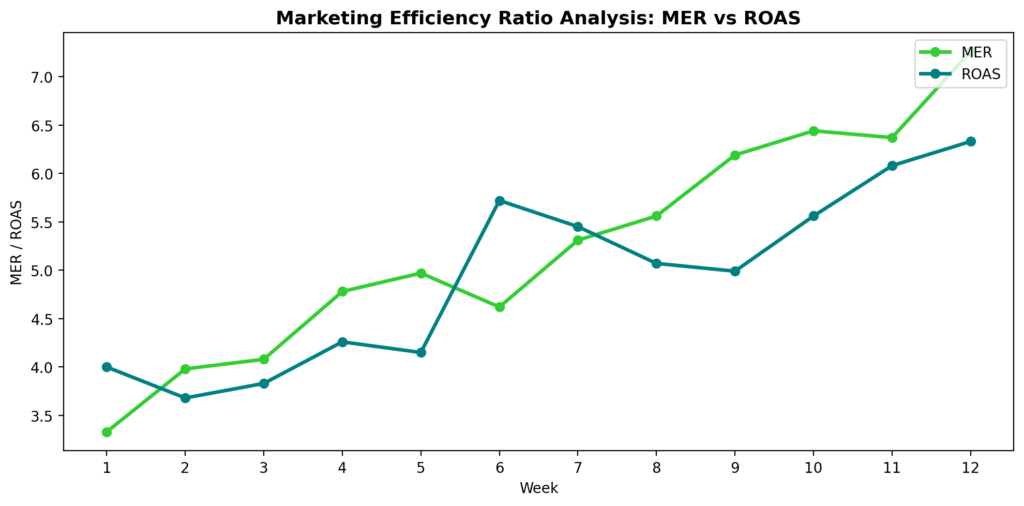
People often confuse MER with ROAS, but they measure different things.
- ROAS (Return on Ad Spend) looks at revenue generated by a specific ad, campaign, or channel relative to what was spent on it.
- MER (Marketing Efficiency Ratio) looks at total revenue relative to total marketing spend across the whole business.
ROAS is valuable for evaluating and optimizing individual advertising campaigns, but it does not provide a complete picture of marketing performance. A campaign may achieve a high ROAS while shifting sales from other channels or overlooking the broader impact of brand-building efforts. On the other hand, MER addresses this limitation by evaluating the overall effectiveness of all marketing efforts combined.
Why MER Matters for Business Planning
MER helps businesses make better strategic decisions because it reflects overall marketing efficiency rather than isolated campaign performance. Benefits include:
Simplifies decision-making
Instead of juggling dozens of channel-specific metrics, leadership can track one clear efficiency number. For instance, a founder can glance at MER before a board meeting instead of reviewing ROAS across five advertising platforms.
Budget Allocation
Businesses can determine whether marketing investments are producing sustainable returns. If MER declines as spend increases, it may signal diminishing returns, indicating that additional marketing investment may be less efficient.
Growth planning
MER helps identify whether increasing marketing spend is likely to generate proportional revenue growth. A stable or increasing MER as marketing spend grows indicates that the business can continue investing while maintaining marketing efficiency. However, a declining MER may indicate that adjustments to the marketing strategy or channel mix are needed.
Executive Reporting
Since MER summarizes overall marketing effectiveness, it is useful for communicating performance to stakeholders and management. Instead of explaining ROAS for each marketing channel, marketing leaders can rely on a single MER trend line to show how overall marketing efforts drive revenue.
Common MER Benchmarks
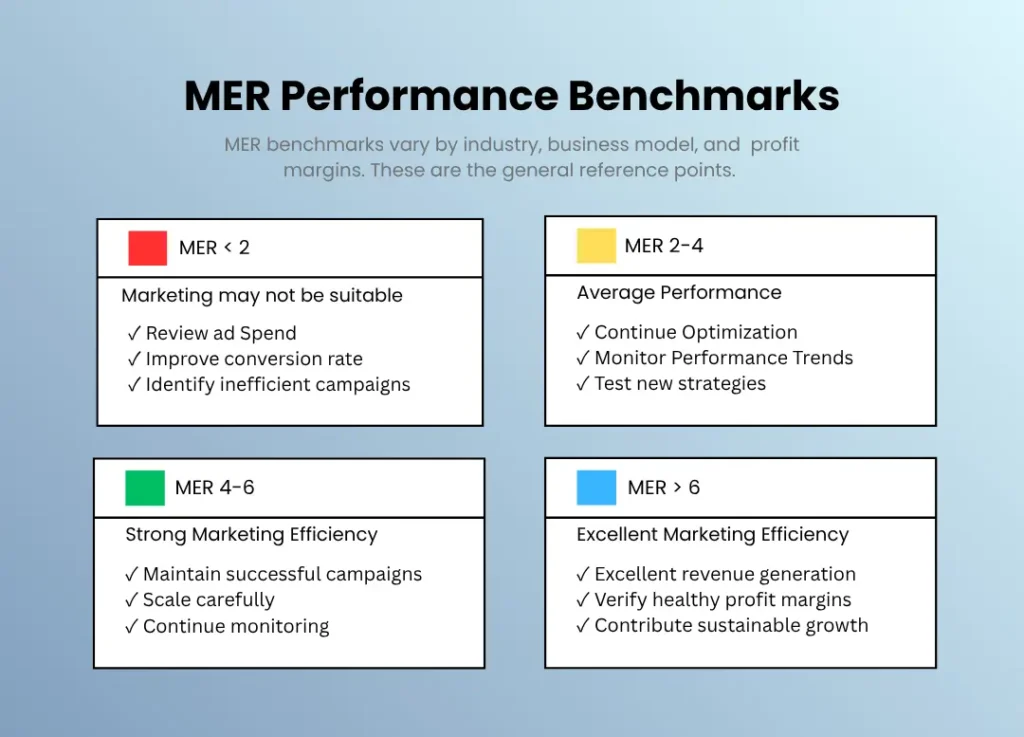
Rather than comparing your MER to another company, it is often more useful to monitor trends over time and compare performance against your own historical results. MER benchmarks should be used as general reference points rather than strict performance targets. A consistent upward trend is often a better indicator than comparisons with industry benchmarks.
Limitations of MER
Although MER is valuable, it should not be used as the only performance metric.
Some limitations include:
It does not measure profitability
A high MER does not necessarily mean the business is profitable. Cost of goods sold, shipping, discounts, and operating expenses must also be considered.
It does not identify which channels perform best
MER combines all marketing activities, making it difficult to pinpoint which campaigns drive the strongest results.
Attribution challenge
Customer journeys often involve multiple touchpoints before making a purchase. MER cannot determine which channel deserves credit for a conversion.
How Data Analysis Improves MER Interpretation
Raw MER numbers only tell you so much. To get real value from MER, it helps to layer in deeper data analysis:
Trend Analysis
Track MER weekly or monthly to spot patterns rather than reacting to daily noise. A daily pulse report can still be valuable for monitoring performance, flagging unusual changes early, and ensuring teams stay informed without over-interpreting daily fluctuations.
Segment Analysis
Analyze revenue and marketing spend separately for new and returning customers to understand how marketing efficiency varies across different stages of the customer journey. After identifying differences across customer segments, techniques such as market basket analysis can also reveal purchasing patterns within these segments, helping connect marketing efficiency to actual buying behavior.
Correlation with external factors
Compare MER against seasonality, promotions, or pricing changes to understand what’s really driving efficiency.
Combine with contribution margin
Pairing MER with profitability metrics gives a clearer view of whether “efficient” spend is also profitable spend.
This kind of analysis turns MER from a single number into a strategic decision-making tool.
Frequently Asked Questions
Is a higher MER always better?
Generally yes, but context matters. A very high MER paired with flat revenue growth might mean you are underspending on growth opportunities.
How often should I calculate MER?
Most brands track it weekly or monthly to catch trends without overreacting to daily fluctuations.
Can MER replace ROAS entirely?
No. MER is great for big-picture planning, but ROAS and other channel-level metrics are still needed to optimize individual campaigns.
What’s a “good” MER?
It depends on your margins and business model, but 4-6 is a commonly cited healthy range for many e-commerce brands.
Conclusion
Marketing Efficiency Ratio (MER) gives e-commerce brands a simple way to evaluate how effectively their marketing investment generates revenue. Unlike campaign-specific metrics, such as ROAS, MER provides a broader view of performance by accounting for all marketing expenses rather than individual campaigns.
Although MER should not be used on its own, it becomes much more valuable when combined with profitability metrics, trend analysis, and channel-level reporting. Together, these insights help businesses make more informed budgeting decisions, optimize marketing investments, and support sustainable long-term growth. By tracking MER alongside other key performance indicators, e-commerce brands can gain a more complete understanding of the impact of their marketing efforts.